Thursday, August 6, 2009

"L'enfant" (2005)


The film, as many films do, emerged from a single image: the sight of a young woman pushing a baby stroller. If she had pushed it along as all young 1st time mothers do, gingerly, carefully, then perhaps L'enfant would never have been made: but she did not push the stroller gingerly, she pushed it almost with force, rather violently, as if no baby lay sleeping inside, as if it were empty, and yet, there indeed was a child no more than a year old in the carriage, in spite of all his mother's efforts, soundly asleep. The brothers Dardenne stopped her and politely asked to peer in at the ensconced baby, because they were 'fond of children'. And the young mother wordlessly allowed them to look at the uncannily placid infant, and when the brothers had gotten their fill, and resumed their work on the set of Le fils, the taciturn young mother jerked the stroller onward, as if it were a tremendous but unavoidable annoyance, and the child remained asleep and oblivious to all the power it vexed on her. The Dardenne brothers did not forget this image, and when they could not rid it from their minds, they decided to make a film on it. That film is L'enfant.
...
Since the commencement of the 21st century, a new cinema has emerged which fuses the increasingly motivational vogue of nonfiction with the perennial methods of fiction. The death of fiction that resulted from last century's postmodern wave (and I speak here of the death of fiction in all those arts irreparably affected by multimedia integration) has killed off certain markets, or at best, committed such trenchant plastic surgery that the old idols are no longer recognizable. Television passed on from the literary & cinematic slow-burn elegance of The Twilight Zone to the fact-gorged, hi-speed technical pornography of shows like E.R. or C.S.I. (the initials on their own testify to the passing of faith from unauthenticated myth-making to ultra-authenticated scientific fiction in which acronyms replace latin roots, and encyclopedias replace bibles). The book market is an ostensible case in which a glut for biography and nonfiction and book-length newsworthy items has overtaken the augustan urges for paper wisdom; when fiction at all, our current bestsellers are of the fantastical Harry Potter-Star Wars-Batman kind (which unsurprisingly are purchased more rabidly by the sugar-cereal-eating adults who make and spend money on comic book collectibles, than by the children they raise), or of the 'controversial politik' kind - (i.e., fiction that dresses up central issues like 'the plight of Iranian women'; or the introduction of Balzac or Nabokov or whoever else is on the western humanities roster to an eastern 'repressed' country; or it could take form as a heartwarming tale of boys who flew kites in a war-torn country, only to grow up and become disillusioned and grow apart in their differing ideological stance, and then find peace by flying kites in the sky again, instead of bombs, etc. etc.) - politically charged fiction, in short, that allows for its readers to feel simultaneously informed, involved, and emotionally elated. These are the smart consumers who shop at Whole Foods, who aspire to capitalist sanity in their secular global-community collectivist faith, by being good and honest capitalists who buy organic and read books 100% backed by research and fact-checking organizations.

The arts would degenerate into a uselessness that took shape as one extreme or the other, either Harry Potter and the Eaglehead of Aztlan or the factchecked fable of a north korean girl who learned of the world outside her door when she picked up an old tattered copy of Dryden's verse translated to korean by her dead poet father (who of course perished defending the ideals of the north in the civil war, long after he gave up poetry). A crystal ball on one hand, and the newspaper in the other.
...
Yet film has been able to survive the amortizing effects of the postmodern wave, and transform by virtue of its reliance on a uniquely composite technology. (It may even be asseverated that film had predated postmodernism long before the latter reached its literary apex: postmodern thought was invested in making the velocity of popular culture a philosophy - if one could reduce its stylistics to a phrase - and so it was natural that the speediest of artforms would antedate, as a time machine only could, the expression that brought it to focus: so too did life exist before it could be given testimony by the camera.) Film was a means of bringing to focus the verity of life in its directness: it is to this day an artform of the present tense.

Without having to delve into the early decades of film, when the bulk of it was still attributable to the elder master arts, it would be enough to declare that film up to now has been balanced on a synthesis of the proven methods of fiction in literature with the ineluctable advancements of the camera. In any case film has been greatly dependent upon decidedly literary standards foreign to its own capacities. Film in spurts would ever be pure film: only a few artisans - those whom we eagerly baptised masters of the form - were courageous enough to sink into and allow the thoroughly non-literary aspects of cinema to overwhelm the baser need for practical narrative. When a film was purely itself, we would recognize in its imminent frame the ontology of a singular image. Pure film, after all, was iconic: a single image was enough to substantiate a cinematic experience. So certain artists would tire of constructing vapid narratives to dress up the one image that germinated the entire vehicle: cinematic artists began to think cinematically, and they realised that the advantage of filming photographically - sans care for how the image fit into a greater story - was that it brought them in direct communion with the actual stuff of film: life, life, life.
...
The Dardennes brothers did not foresee how greatly the story data would morph from the 1st time they laid eyes on the baby-stroller mother, to the time they began photography on L'enfant. The disgruntled mother eventually became Sonia, and Sonia became sympathetic: she loved and wanted her baby, eagerly, lovingly. The brothers initially desired for Sonia to search for a man, a father for her child... and then that story changed, and it was Sonia searching for the father, for Bruno, to whom the story brought its focus. Yet the image remained: the mother pushing along the baby stroller became Bruno, the father, pushing an empty carriage in which a baby once slept. In cinema the story can just as easily be meaningless, the 'facts' can change, the characters change sexes, and a baby reappear after it had disappeared seemingly for good. What is of the utmost importance is that the image remain the same, that it remain pure and 'beyond all parting'.

L'enfant is a small film, a minor film, but it works like a miracle. Its smallness of purpose - to produce an impression of a life lived according to its meagerest constraints - goes beyond socio-political savvy, past the self-importance of politically-judicious commentaries that revel in occident/orient, working-class/bourgeois, dark/light dichotomies. It will feel an insult to simply call it 'a day-in-the-life', and yet, that is essentially what it is and what it does: it does not just capture a slice of life, it builds up a rhythm that absorbs the inimitable nonexistence of our waking hours. It uses rhythmic art to enforce an urgency of life on a sedentary gazing body, as Bresson's films so flawlessly accomplish. (In this respect it is as clear that the Dardennes brothers take as their inspiration the Bressonian method, as it is clear that Aronofsky took from the Dardennes the praxis & stylistics on display in The Wrestler.) L'enfant is a flagship for the Dardennes, and the Dardennes are a flagship for the new cinema: a cinema that no longer concerns itself with the old narrative artifices, that no longer mimics documentarian facets or simulates true-to-life intensities; their cinema is a humane cinema that purely and directly and unequivocally portrays life as a means of expression, not as its result. Neither meditation nor remembrance, neither drama nor 'story', L'enfant is a film directed in the present tense.
...
One more observation: the other belgian director of the new school, Bruno Dumont, achieved similar expressiveness in La vie de Jesus, after which he had fallen off the scale of acclaim in the eyes of not a few critics. One must point out 2 striking features that separate the Dardennes' work from Dumont's: the Dardennes have demonstrated greater technique in their handheld work, instilling in the viewer a variety of sensations akin to the present tense, to direct contact. It is difficult to stress how exceptionally gifted the Dardennes are in their handheld work: their handling of the camera impersonates the faculty of human attention without crudely jolting or nauseating it (as so many other inferior handheld 'artists' end up wrecking on the audience); Dumont, however, prefers single still-frame shots, and rather creates sensation through imagistic or narrative provocation. This is the 2nd attribute that not only separates the Dardennes from Dumont, but also causes some to have distaste for the latter director: Dumont is willingly provocative, and continues to lunge toward demystifying sexuality through banality. Dumont deals exclusively with the metaphysics of banality and as such risks its hazards himself. The Dardennes, conversely, do not treat of banality for its own sake, but utilize its innumerable moments of 'breathing time' to construct rhythm and emotional resonance. L'enfant is filled with countless moments of breathing time, as for instance when we find Bruno (played so vividly by the professionally non-professional Jeremie Renier) waiting in the police department to be admitted into the inspector's office: he for a few precious seconds stares off into the distance of the room, in brief contemplation of what he is about to do: confess to a crime from which he could as easily escape. The speed of the film is so brutally quick, as life too often is, that the many authentically present-tense moments of breathing space feel like eons in the consciousness of a boyish young man who still plays with sticks in the water, who behaves and acts like a child himself (the film is titled L'enfant because it plainly asks us, who is the child? And we know the answer when we ask in turn, who then do we see before us, who is being led by the camera from frame to frame, toward his catharsis?) By the time Bruno realises that he is a father for good or bad, time catches up and swallows him, as it swallows us, in an outburst of tears, of genuine, inescapable emotion.
...

Monday, July 27, 2009

"Waltz with Bashir" (2008)


War erases memory. How? One chooses to forget (against one's own will, but in accordance with desire's tyranny over the emotions).
...
26 rabid dogs will become 26 wailing palestinian women. Symbolic moral of the story.
...
A film that owes much to Resnais' Nuit et brouillard: the camera captures selectively, so too doth the memory: but the progression from animation to live action, and from live action to documentary, is an arduous, bitter, and tormenting road. (Analogous to the concept of Purgatory - in which images are cleansed of their illusion, and made carnal; or conversely, in which flesh is stripped from the spirit, on the path toward purity of form.)

So we pass forth from israeli postmodern nihilism to inner jewish anguish. The palestinians are the jews of the holocaust; so we learn. And the bitter pill of total recall posits that the israelis mimicked the old satanic beast of the 3rd Reich; so does history repeat itself, against the will of the many.
...
The film raises questions on whether animation diminishes the impact of reality, and especially whether it is able to mitigate the harsh realism of war: we are exposed to animation of lower speed, a speed so slow as to grate on our minds made oversophisticated by the Disney and Pixar films, yet compensated by the glaring stark colorisation and the thick-bold stenciled renditions of the characters. An animation film filmed in the yellow and gray of rubble & decay, and in the blacks and whites of war-ruminations. Does war emanate well and truly, on this plane of fiction? No, it does not: but then, does film have at all the capability to render the authentic history with its brutality and its dry irrational serenity intact? Perhaps it can, very often it does not: it will in any case manifest, as the 'fog of war' perennially will, a dream-state that either denies our involvement or barely, sluggishly implicates it. We struggle to be 'involved' in the realism of war: we are either the voiceless dead, or the former soldier who in his isolation is unable to communicate the power with which fear overtook & shot through him like cold thunder in his swift blood, making him a stranger to his own remembrance, a stranger to his own experience, which now so distant, comes across as a fable lived by an Other: a killer, a victim, a coward. One does not readily admit to being any of these: so one constructs fables, which one is at liberty to animate, to paint over, to give humor to.

But precisely when we have grown tired of what could have possibly been (did the massacre take place? did we do enough to prevent it? were we there when the boy was blown to bits by the rocket that the comrade shot? perhaps we were there, and just as now, we then had no voice, no will, no way of stopping what became a memory, a falsified photo, a video, an animation of atrocious acts that took place somewhere in time, irreversible) ...precisely then, when we are most distant from the mysterious iniquity that upsets our sleep each and every night, does the cavalcade of cries uproot us from our ignorance, assailing us with the thunderous lament of ghosts who continue to dwell frightfully in the camera lucida of memory.

The director wishes to wake us up from our placid sleep of cartoons: that is his mission, and it is, as point of reference in cinematic art, a paradoxically timely and tardy one: timely because he is a citizen of his country who speaks (in)directly to his generation - tardy because the film attempts to work as an evil curse does, to steal our sleep by forcing us to witness what occurs when the cartoon-sleep like ghoulish paint - like a mask on the demon's visage - peels away from the scorched surface of news-video-realism.

It is however to the director's detriment that in spite of his perceptibly honorable purpose, the film does not build up with efficacy the rhythm that more capable directors have mustered in war-films that were, ironically, purely fictional. He begins with fiction and ends with nonfiction, starkly, too starkly. The dramatic rhythm which he creates in the first half of the film is destroyed by the introduction of pseudo-documentary interviews with personages (still animated) connected to the massacre at the heart of the film: these accounts end up lulling the viewer rather than captivating the intelligence: we are enjoined to treat these accounts as authentic, and to feel a sense of guilt over the proceedings. But the transition is overly intellectualized, and the obviousness of the animation/news-footage, or fiction/nonfiction dichotomy belabored past sympathy. What ensues is confusion, uncertainty, and guilt: emotions that are as easily aroused as those feelings which pornography effortlessly raises. A pornography of news-realism, similarly deceptive as the techniques of animation.
...

Sunday, July 26, 2009

Portraits of Friends - 3

To Oscar
...
Yea,

whiskydrowned, like shipwreckt men
who paddle away from the lighthouse
toward winedark waves,

we sought vortices in the grooves of records,
the sublime silences enraptured in the white noise
of unopened books.

We were the solitary ones who read aloud to no one:
at the back of the classroom we bespoke orations
marbled by meticulous men, & carried priestly books
like proud lovers gorged on the whiteboned immortal
dead, our thoughts configured by apparitions of order
in our unlikely context,

we, the self-taught californians,
who invented our own prestige.

You in your hi-desert heat heard
the plangent call for impavid voyages:
a sound of waves, a prodigal
horn impassioned by a slur of windcry.

(In you the stroke & counterstroke
of Coltrane, of Kierkegaard,
sublimest reduction.)

I then had awoken from suburb sleep
to a monstrous dream of riptides,
possessed of the image of one
who read H. Crane as if it were felonious:
we circumvented the curriculum
& constructed our own bridge
across that miasma of shopping malls
& raised trucks;

those obscene 6-lane roads,
and where no roads were paved the dirt & desert rocks,
kept us inward, hermits at a threshold
fashioned from borrowed erudition,
we trekked from towns to metropolises,
from cities to cathedrals & from letters to the words
that were bricks in the cathedral that was a book
that were pages, white pages like cloudy waves on which
our brown bookish galleon steadied itself & rocked & surged:

& onward through speeches
of women & gin, a philosophy of love
that in ample fugues led us
to the nightly-pier, exhausted
from talk and eager for dialogue
with the whorish untouched moon:

We gazed up at her with tremulous
washedout eyes,

'the seal's wide
spindrift gaze toward paradise.'

Thence came the waves, the waves
that came from lord knows where
those waves of stupendous godly
inebriation the forgetful waves
of remembrance, the virgin waves
of chastity, the spume waves of sex:

& in that car racing at 5am
when the outer sphere still swam
in the starspotted sea I remember
not what I remember clearly but
I remember the waves coming toward us
and you bellowed out that passenger window
in strange righteous sulfurous agony,

'Here comes the ocean!
and the waves,

where have they been?'
...

Wednesday, July 22, 2009

"Tetro" (2009)


Something's been made of Coppola's 2nd youth, a recent period in his filmography that began (appropriately) with Youth Without Youth in 2007. That film materialised exactly 10 years after The Rainmaker, which in 1997 had been a modest but energetic adieu to a director whose last notable achievement was the fantastically old-school, sumptuous production of Dracula. One of the more consistent traits in all Coppola's oeuvre is his careful selection & control of set and production design. Shining examples are Dracula and, of course, The Godfather films: these films exhibit atmosphere, and even where black holes congregate in the plot and the dialogue fails, overwhelmed by editorial pandemonium (as famously occurs in Apocalypse Now), or when the melodramatic swarms the screen in overtures, the ambience of the production set & the location, its characters & flora, the overall gleam of the screen muffles those parts of Coppola which are inescapably and anachronistically italianate: his love for the operatic, which pervades even his smaller-scale films.

Youth Without Youth, a film that begins promising, as it presents a terrific opening title screen (the 1st in the revamped American Zoetrope production line) that boasts something along the lines of a metaphysical 3rd Man, gradually degenerates as it develops its ludicrous plotline. Mircea Eliade after all was no professional novelist. Nevertheless, YWY's one admirable trait is its sense of atmosphere, allowing us at least to breathe a little of the Old World lovingly romanticized by the director.

Sunday, July 19, 2009

"Les bonnes femmes" (1960)


A 3rd film by a man, about women (in the plural):
...
Touches of Fellini: nightclub scene, men masked as pigs or jesters, accompanied by scanty-clad young ladies and older obnoxious harlots, gathered around a long table cluttered with champagne bottles and glasses full and empty and tipped over, confetti, party streamers, dim lights, while a lascivious blonde (a la Anita Ekberg) dances and strips to raunchy afterhours jazz.

Hints of italianism everywhere: a saleswoman attempts to teach one of the clerk girls how to enunciate an expression in italian. The stalker - who prefigures the film's disarmingly elliptical plot - looks viciously italian, dressed in a motor-jacket and driving a motorcycle (reminder of Rocco & His Brothers, released the same year).

What does the film propose? That men are predators, pigs, & pansies. That the good women simply seek romance, 'true love'. What surrounds them is an ambiance of desire, strangely debauched or disenchanted in unforeseen ways. Paris by night. The film, from the title credits to the end, is brought to life by a peripheral love for the hermetic charms of Paris. These good women are infused by Paris, driven by Paris, enraptured by it: they seek love in Paris because they are in love with it. Yet in the particularities of men, they find none of Paris' allure: only the vulgar insidious backs of men's necks, the lurid sight of hairy arms.

Point of comparison (to Mizoguchi's Sisters of the Gion): the men escort the young ladies in a shiny cadillac, on their way presumably to riotous drunken fun. One of the girls, Jacqueline (the romantic one), asks the men, "Where are we going?" To which the joe on the passenger side leans over and with sinister insinuation answers, "Don't worry about it." Exactly the same scene occurs in Mizoguchi's Sisters of the Gion: except the insinuation does lead toward miscreancy, and the girl ends up beaten and thrown off a cliff. (If it had been made now, she would no doubt have been raped.)

The soundtrack music channels doom, intrigue, mystery. Chabrol even when young demonstrated an ability to create unearthly tension, disconcerting for us because the tension emanates from nothing in particular: a stray glance, an awkward silence, a sudden zeal for laughing. Chabrol even when young was attracted to murder: before Lynch, after Mizoguchi, he was a director exclusively interested in the subject of 'a woman in danger'. Yet nothing in this film prepares us - as his later films formally do - for the sharp turn it takes down a dark dark passage: the denouement leaves us thoroughly floored and nervewracked.

The brilliance of this film shows in the bizarre but preternatural fusion it makes of the dominant cinema-trends of the time: it is proto-Chabrol, post-Hitchcock, quasi-Italian, semi-Nouvelle Vague. Somehow deceptively gleeful & struck by a morbid Nights of Cabiria-like romanticism, Chabrol anticipates his own brand of perverse irony.
...
(Of the fraction of Chabrol films I've thus far seen, this is undoubtedly the one which has impressed on me the exorbitant powers he lays claim to, and which he promised as a young filmmaker. As an older director, I cannot say that he has matched the exuberance and terrific abnormality of this one.)
...

Saturday, July 18, 2009

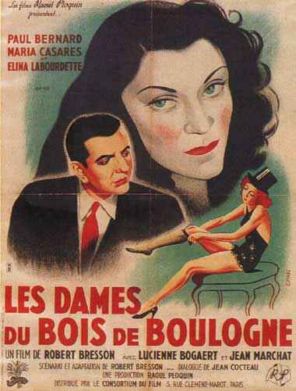
"Les Dames du Bois de Boulogne" (1945)


Perfection in art, per the french classical sense of it, derives from an economy of style that wizens down the particulars of narrative to bare, unornamented, wholesome elocution. The performances of Racine exemplify the ineluctable and spartan measurements of the french style: an unequivocal, studiously controlled passion d'ĂȘtre. The rule of persuasive parsimony applies to 4 of the art-realms that have had strong french traditions: the architectural, the literary, the pictorial, and the cinematic. The grand austerities of Corot demonstrate a profound learning of antiquity and a sensibility for undramatic order; even the plainsong gesticulations of the Impressionists suffice to point out those counter-narrative pictorial elements that correlate across periods of deferment. In cinema we have the felicitous aesthetic purity of Jean Renoir, and what came after Renoir, for which no greater director exists so circumspect & exact as Robert Bresson. Bresson in cinema would be, as Tarkovsky stressed, just & only Bresson, just himself and no other; but Bresson would also encourage in his matchless figure a possible summation of all that french cinema could be when removed from those alloys that were not distinctly french. Bresson was indeed himself, but he was also a return to Racine & Pascal & the french intelligence of the Port-Royal movement, since he was by some indications a thinker of Jansenist proportions.
...
Les Dames du Bois de Boulogne was erstwhile known as the film that was Bresson the filmmaker before he would become Bresson the artist; traces of the future would be here-and-there gleaned from an otherwise seemingly straightforward film. But this is imprecise. Bresson is never 'straightforward', and LDdBdB is a film that very carefully & subtly assembles the parts for a truly sublime denouement. The film exists for its climax, when we witness the visibly cool emotion of perfect revenge on the face of the otherworldly Maria Casares as she stands by and watches a frantic, nonplussed Paul Bernard attempt to drive away from the scene of his social humiliation. It would be enough for the film to end there, magnificently on a note of clever subjugation, but uncannily, with equally perfect execution, Bresson has Jean (Paul Bernard) come back, a newly dejected and fearful man changed from his once haughty, careless ways, and step into the sombre bridal chamber where his new bride, a debauched danseuse, awaits him. What occurs during their final, momentous encounter is indescribable: something like the unheard but perfumed wings of grace, irresistible even for the commonest, basest, most ordinary men to obey (here we glimpse cinematographically Bresson's Jansenist inclinations) weighs down on the impure lovers from the height of Bresson's angled camera-eye, and their embrace, occluding the constraints of societal pressures & aristocratic biases, brings together so miraculous an understanding of souls that any remembrance of what had occurred before is wiped off the screen in an odour of angelic harmony. (Bresson believes in irresistible grace, and some of his films are renowned for ending on notes of classically rapturous epiphany: viz Diary of a Country Priest, and A Man Escaped)
...
Without having to refer to the exquisite sense of perfection that the film alludes to (though not actually achieving it to the fanatical degree that Bresson would pursue later) Les Dames du Bois de Boulogne evinces once and for all Bresson's place in the classical french tradition; firstly, as a director capable of Renoir's humor and equanimity; and, secondly, as a director who allows for complete transparency in the omission of suggestive interpretations. Les Dames is a successful adaptation of Diderot's work, and a good expositor of Cocteau's dramatic flair. Bresson comes away with a high-grade for conventional filmmaking, yet manages to explode the ending in filmic terms that defy categorization (unless we can properly assess the ending as something akin to the science of miracles).

Wednesday, July 15, 2009

"Sisters of the Gion" (1936)

...
An auction. Seated bidders excitedly shout their desires and gesture commercial instincts, in the hanging heat of the small shop space, fanning themselves vigorously. The opening of the film bespeaks a young director's evident fondness for the latest technique: a lateral tracking shot that captures the energy of the auction, the rapid discourse of objects sold by catalogue numbers and quick glances. One has yet small clue as to how the conventional japanese concern for financial ruin (conspicuously the more shameful of shameful misfortunes that could befall a hero of early japanese cinematic fiction) will come about, the perennial theme of minor muted tragedy.
...
Gion, district of Kyoto, the premier nexus for the geisha practice. By the time Mizoguchi came into awareness of his powers as a storyteller, he focused his attention on a central institution of japanese culture: the geisha myth. 1836 Kyoto: famine, rural uprisings, the Tempo crisis, western flirtations with Japan. By 1936 the west had infiltrated Japan through the media of popular culture: young women wished to dress like Greta Garbo or Joan Crawford. Kyoto was no longer the Kyoto of old, and the legendary Gion district was a relic of former luxuriance, wealth, & artistry. Debt to the indebted, the new order of the day. The patriarchy had run out of cultural capital, and young women were becoming empowered. Mizoguchi discovered a powerful subject to capture and exploit: the plight of women on the uptake.
...

The sisters in question are Umekichi and Omocha, complete opposites in temperament and belief. Umekichi is the older, traditional-minded geisha, who stays loyal to her few benefactors, even when the men who had once supported her can no longer sustain their own lives. Omocha, younger, prettier, and a hundred-times more ambitious, plays the New Woman, the 20th Century Woman, the Liberated Woman: she is a geisha too, but with her awareness of the commodity she presents to her current and future clients, uses her charm, wit, and language to her own advantage; when a client can't feed or entertain her properly, or buy her a decent kimono, she dumps him immediately; she fishes the fishermen, looks for the Big Fish, cares not a whit for the man's age or attractiveness. What matters is capital, and the thing that lasts the shortest time is love.
...
Mizoguchi uses the parable of 2 sisters, analogues for the Old World and the New, to showcase the problems women face in a shifting, unpredictable economy and a patriarchal culture losing its traditional currency in a world turned more liberal and increasingly capitalistic. That neither Umekichi nor Omocha deserve what they receive at the end is far from the point; Mizoguchi after all directed Osaka Elegy the same year, starring a female protagonist almost exactly Omocha's doppelganger: headstrong, voracious, implacable. He is not concerned with moralizing over the world's unfairness to these women, but he does care that we see they will, in the end, survive: what matters most to Mizoguchi, the artist, is the iconic sight of Omocha (and Osaka Elegy's Ayako) defiantly resisting the patronage of men, swearing aloud that she will persist despite her fallen state...
...